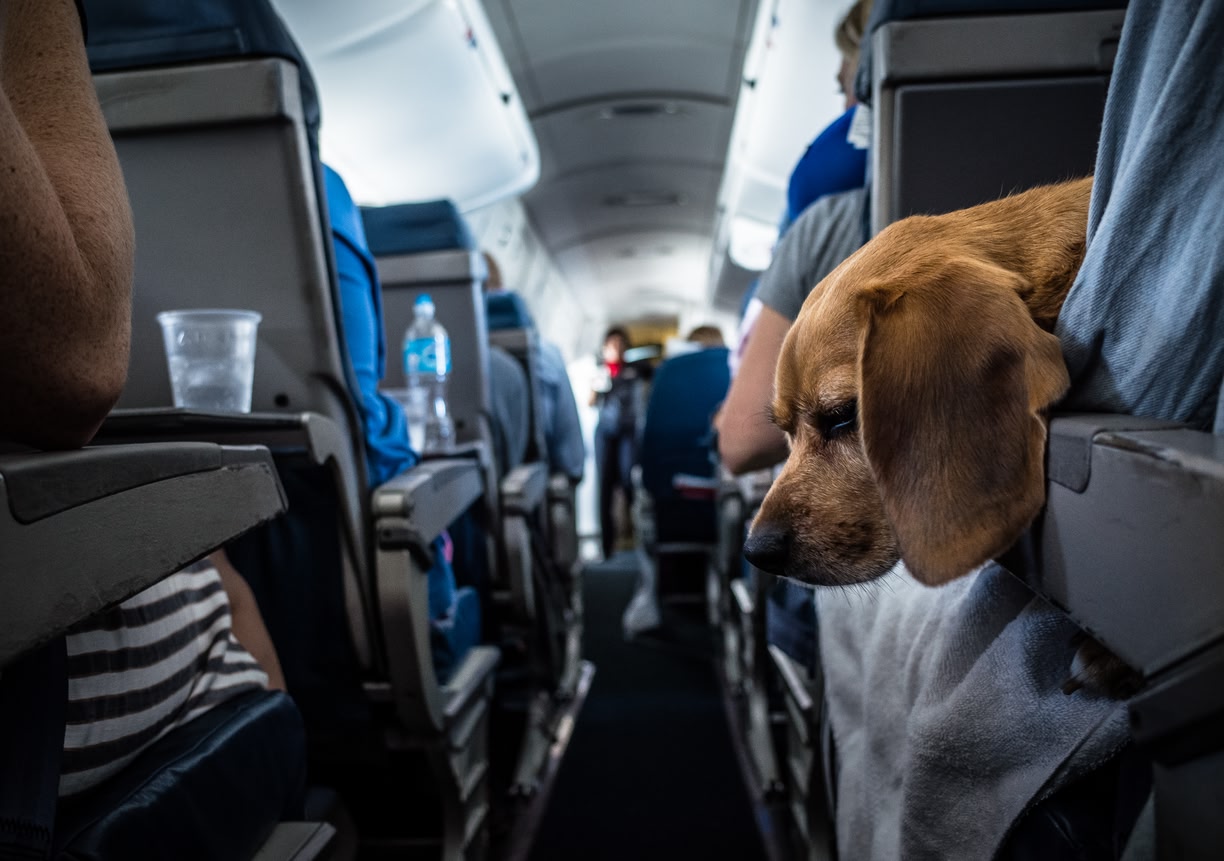
Relocating or planning to take your pet on vacation? Before booking your ticket with Air Canada or WestJet, read these tips on flying with pets.
How does flying with pets work?
Many airlines allow travellers to bring their pets along for flights, whether you're flying a few provinces over or to another continent entirely.
To ensure safe travel for your pet and other passengers, airlines have certain rules regarding pet size, weight, carriers, type, and more. For instance, smaller pets can sometimes travel in a carrier in the aircraft cabin with their owner or caregiver, while larger pets typically must travel in the aircraft’s climate-controlled baggage compartment. Not all airlines allow travellers to fly with their pets, and those that do may have conditional or temporary restrictions, such as limits on the total number of animals allowed on an aircraft.
Planning ahead and checking all the details of your travel helps everything go smoothly on departure day, so it’s important to research the airline's pet policies.
Travelling with pets internationally
Regulations for flying within the same country are relatively simple, but flying internationally might require additional processing, proof of vaccination, and, occasionally, a mandatory quarantine period of up to 120 days. Remember that, if your pet’s flight has layovers in other countries before its destination, you must meet the entry requirements for each country. For example, Hawaii is rabies-free, so travellers must satisfy firm vaccination or quarantine requirements.
Depending on the general entrance requirements for pets, it might make more sense to leave your furry friends at home with a pet sitter. If you choose to fly with a pet, check the requirements and get organized well in advance.

Preparing to fly with your pet
With the right preparation, travelling with animals can be easy and stress-free for everyone involved.
1. Let the airline know about your pet
This step is non-negotiable — you need to communicate your plans to bring your pet with your airline in advance. It's best to reserve space for your pet when you complete your booking, or at least 48 hours before your departure, to guarantee that the flight has space for them.
If you need to change your reservation at any point, contact the airline to change your pet’s reservation, too. When checking in at the airport with your pet, arrive at least 30 to 40 minutes earlier than you normally would, about 2.5 hours ahead of departure for domestic flights or 3.5 hours before US and international flights.
2. Take shorter flights (if possible)
If possible, minimize flight time when travelling with pets. Opt for direct flights instead of layovers to avoid potential mistakes during airline transfers, delays in reuniting with your pet, and complications meeting entry requirements for multiple countries.
3. Get travel insurance for your pet
Some airlines may limit liability to checked baggage and exclude pets under that policy, leaving them unprotected in case of an incident. To protect your pet and minimize potential costs, research pet travel insurance options for coverage between your departure and arrival points, such as delayed flights or emergency vet bills.
Alternatively, certain pet health insurance policies may have built-in medical coverage for pets travelling abroad. Specifically for flights, pet travel insurance coverage may cover these flights for your pet or service animal:
Lost or stolen pet assistance
Liability coverage if your pet causes injury or damage
Quarantine kennel fee coverage
Lost or stolen pet passport or health certificate
Trip cancellation or trip interruption due to emergency pet illness or vet visits
24/7 helplines for pet emergencies
4. Take a trip to your vet beforehand
Scheduling a comprehensive, pre-travel check-up with your vet ensures that your pet is healthy and fit for travel, especially if they're travelling in-cargo and unable to be accessed during your flight. For example, pets may have time-sensitive medication needs, anxiety, or have medication schedules that may be interrupted by flight schedules. Verify that your pet's vaccinations are up to date and request a health certificate that meets airline and country-specific entry requirements.
5. Invest in a good pet carrier
An airline-approved pet carrier or kennel promotes comfort and safety for your pet. In general, airlines require that kennels are in good condition, within dimension limits, but still large enough that your pet can stand and lie down without restriction.
6. Label everything (with images)
Label your carrier or kennel with your name, phone number, and pet’s info, so another person is able to easily identify your pet and contact you. In case your phone dies, pack a picture of your pet so you have a recent photo to share if they're lost.
Tips to keep your pet safe and comfy in-flight
Many pets are unbothered by the noise and unfamiliarity of in-flight travel, but a few strategies can help guarantee their comfort and safety:
Go leash-free: Remove your pet’s leash to reduce the risk of an accident.
Feed your pet before the flight: If your pet's normal mealtime overlaps with your flight, feed them several hours before departure, and offer them a snack or small meal after arrival if they don't appear nauseous. Avoid feeding them immediately before a flight to reduce the risk of motion sickness and accidents.
Keep water out of the carrier: Your pet needs enough water to stay properly hydrated, but not so much that they'll have an accident or be uncomfortable during the flight. Allow consistent sips up until check-in. For in-cargo flights, leave an empty dish in the carrier for airline staff to fill if there are delays.
Bring a towel: Cover the bottom of the carrier with an absorbent material, such as a blanket or towel, in case of accidents.
Tire them out: Tire your pet out with a long walk or playtime before heading to the airport, so they can take a nice, long snooze during the flight.

Smaller pets may be able to fly in the cabin | Skyscanner Canada
Bringing a cat or dog in the aircraft cabin
Certain airlines allow you to bring a cat or small dog in the plane cabin as a carry-on item, often with an additional pet fee, depending on your fare allowances.
Carriers must fit carry-on baggage dimensions, which can vary between aircraft, and they must also be leak-proof and well-ventilated. Most airlines allow travelling with a cat on a plane in the cabin since they're usually within size limits, but dogs aren't always guaranteed.
Airlines require carry-on pets to travel in flexible, soft-sided carriers. The carrier and pet must remain under the seat for the entire duration of the flight, so the closed pet carrier must be able to fit under the seat, and your pet must be able to stand up, turn around, and lie down inside the carrier.
Bringing a cat or dog in the baggage compartment
On certain airlines and aircraft, your pets can travel in the baggage compartment if they're too large to fit in the cabin. Airlines charge domestic and international fees for in-cargo pets, and there are requirements and restrictions that vary by airline or flight. These include:
Maximum carrier sizes
Maximum weight allowances
Minimum age
Number of pets in one kennel
Seasonal restrictions for non-temperature-controlled or ventilated baggage compartments
Breed restrictions for those at risk of heat stroke or breathing problems
Breed-appropriate carriers
Always ask the airline about the climate-control situation, especially during particularly hot and cold months. If your pet exceeds weight or size limits or is travelling alone, you may need to contact the airline's cargo department. This applies to cats and dogs as well as insects, live fish, corals, and more. Airlines also have the right to refuse any animal that exhibits aggressive or destructive behaviour.

Flying with pets on Canadian airlines
Check the details of these pet-friendly airlines in Canada as you plan your next trip.
Air Canada’s pet policy
Thoroughly review Air Canada's pet policy when planning your trip abroad with a pet. Contact Air Canada if you have any questions that aren’t covered on their website.
Air Canada pets in the cabin
You can bring a cat or small dog into the cabin with you if they're small enough to stand up, turn around, and lie down in their carrier, which must fit under the seat in front of you. Flying with pets is possible on flights operated by Air Canada, Air Canada Rouge, and Air Canada Express flights operated by Jazz, Sky Regional, Air Georgian, and Exploits Valley Air.
Restrictions on pets in the cabin
Not all passengers may bring a pet into the cabin due to individual limitations or aircraft seating. These include:
Unaccompanied minors
Passengers with a medical device that needs to be stowed under the seat
Exit or bulkhead row-seated passengers
Premium Economy passengers
Pet fees for one-way travel have a few exceptions, but overall they range from $50 to $60 within Canada and Canada/U.S. (except Hawaii), and $100 to $120 on international flights.
Air Canada pets in the baggage compartment
If your pet is too large for the cabin policy, they may travel in the pressurized baggage compartment. If they exceed baggage limits, refer to Air Canada's cargo department for more information.
Category | Policy details |
|---|---|
Eligible flights | Flights operated by Air Canada or Air Canada Rouge, Air Canada Express flights operated by Jazz. Codeshare partner flights don't allow pets. |
Pet age requirement | Minimum 10 weeks old and fully weaned |
Pets per kennel | Pets between 12 weeks and six months old may travel in one kennel but are counted as two pets. |
Maximum size & weight | Up to 292cm (115in) total linear dimensions, maximum 45kg (100lb) combined weight of pet and carrier |
Temperature restrictions | Temperatures exceeding 29.5°C may restrict travel; early morning or late evening flights are recommended during high-risk seasons |
Breed restrictions | Short/snub-nosed (brachycephalic) breeds are not permitted |
Special crate requirements | “Strong” dog breeds require reinforced crates |
Peak travel restrictions | Restrictions from September 14 to January 14 for Mexico City |
One-way fees | $105–$126 within Canada and Canada/U.S. (except Hawaii), C$270–$324 for international flights |
Cargo division | AC Animals |
WestJet Pet Policy
If you're flying with WestJet, check the airline's pet policy prior to your trip. For WestJet Vacation packages, you’ll need to contact the hotel separately to find out about their hotel pet policy, since hotels may have separate pet policies and fees.
WestJet pets in the cabin
You can bring a cat, small dog or bird that's at least eight weeks old in the cabin, which counts as your personal item. They must be able to stand up, turn around, and lie down in a soft-sided carrier that fits under the seat in front of you. The maximum height and depth for cabin carriers is 41cm L x 21.5cm H x 25.4cm W.
The WestJet pet policy allows staff to change your seat if space beneath the seat is limited, or to keep an appropriate distance from someone with severe allergies. Pet fees for one-way travel are $50 within Canada and Canada/US, and $100 for international flights.
WestJet pets in the baggage compartment
If your pet is too large for the cabin, they may travel in the pressurized cargo compartment. Review these basic requirements — more policies may apply, depending on your pet and travel details.
Category | Policy details |
|---|---|
Eligible flights | WestJet-operated flights only; pets are not permitted on code-share, interline, or partner-booked flights |
Pet age requirement | Must be over eight weeks old |
Pets per booking | Up to six pets total, depending on aircraft type |
Pets per kennel | Two pets from the same household may share a kennel if compatible; charged separately |
Maximum kennel size | 101cm L × 68cm W × 81cm H (40in × 27in × 32in) |
Maximum weight | Up to 45kg (100lb) combined weight of pet(s) and kennel |
Accepted pet types | Birds, cats, dogs, rabbits, guinea pigs, chinchillas, and hedgehogs (subject to destination rules) |
Temperature restrictions | Extreme heat restrictions apply seasonally and by destination |
Seasonal restrictions | Heat embargoes May 15 to October 31 for many destinations; additional holiday limits December 15 to January 7 |
Breed restrictions | Brachycephalic (short-nosed) breeds not permitted; strong breeds must travel via WestJet Cargo |
One-way fees | $100 within Canada and Canada/US, $200 for international flights |
Cargo division | WestJet Cargo |
Travelling with service and support animals
Service and support animals aren't considered pets and are subject to different rules or exceptions, though the in-cabin carrier requirements are generally the same. In Canada, service and emotional support animals (ESAs) are classified the same way, but Air Canada only allows dogs as ESAs. WestJet also only permits verified service dogs for travellers with disabilities and doesn't allow ESAs.
In either case, you must contact the airline at least 48 hours before your booking to reserve space for your service animal and complete the required registration forms. You may need to submit documentation for your service animal, and you should also carry their documentation and identification in case airport authorities or other service providers need to verify their eligibility.
Air Canada and WestJet have extensive service animal policies, including different reservation and check-in processes. Please consult the Air Canada service animal and WestJet service animal websites for more information.
Ready to travel with your pet?
Sign up for the Skyscanner newsletter and download the Skyscanner app to your phone to keep tabs on all the latest travel specials and deals for flights, hotels, and car rentals.


