Since the biggest culprit of emissions is air travel, you’ll help Mother Earth a bunch by making these responsible tweaks to how you travel around the world. Scroll down below to learn more.
- Book direct flights
- Take a longer vacation
- Explore a place closer to home
- Sit in economy class
- Choose a fuel-efficient aircraft
- Pack light
- Lower the window shades
- Bring your own in-flight gear
- Go paperless
- Offset your carbon
Book direct flights
Stopovers are a pain. And Mother Nature agrees. Non-direct flights involve more takeoffs and landings, which burns more fuel than cruising. When booking your flight, search for an itinerary that has the least number of stops to your destination (which you’re probably already doing).

Take a longer vacation
It’s hard to complain about a stretched-out holiday. The eco case for taking a longer vacation is that you use up more of your vacation days and ultimately fly less. One round-trip flight from New York to Europe or to San Francisco creates a warming effect equivalent of two or three tons of carbon dioxide per person. So for every flight you don’t take, your carbon footprint significantly drops.
Explore a nearby city
If you want to lessen your personal footprint even more, choose destinations that are closer to home. The math is simple: the less distance there is there fly, the less carbon that is emitted. Plus, aircrafts meant for long-haul flights tend to be heavier and require additional fuel.
Short hauls are anything less than 3,700 km. But if you’re thinking of flying less than 1,000 km, it might actually be better for the planet if you take a train, bus or car.
Sit in economy
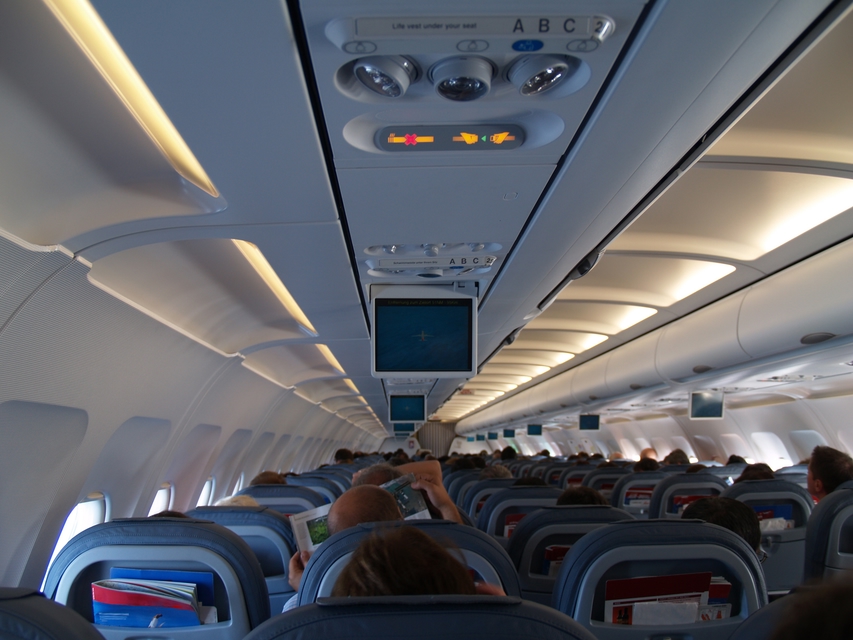
Next time you’re in coach complaining about the legroom, just remember that folks in first and business class leave a much bigger carbon footprint because of all that extra space they have. Some experts estimate that premium fliers hurt the environment six times as much as economy fliers.
Choose a fuel-efficient aircraft
Certain airplane models are more fuel-efficient than others. These include the Airbus A380, Boeing B787-800 Dreamliner, Boeing B737 MAX, and Boeing 747-8 Intercontinental.
Unfortunately, there’s no simple flight search that lets you book flights by aircraft. But if you know what eco-friendly aircraft you want to fly, you can look up which airlines are carriers, and search from there. For example, there are 13 airlines that fly the Airbus A380, including British Airways, China Southern Airlines, Emirates, Lufthansa, and Qantas.
To find the aircraft type on Skyscanner, enter your desired travel dates and times and a list of available flights will show up. Select your desired flight, then select your preferred travel supplier. All supplier websites vary, but generally, there should be an option to view flight details. The aircraft will generally be listed in here, next to the flight number, seat number or cabin type.

Pack light
The more weight that is on a plane, the more fuel that is expended to move the aircraft. Pack for what you need, and not what you think you need. If you are staying at a hotel, you don’t need to pack essentials like toothpaste, shampoo, body wash, and razors. Even if you’re roughing it in a hostel, these items can all be purchased at your arrival destination.
Lighter luggage also makes a big difference. The Atlantic Beaumont carry-on and the Travelpro Maxlite 4 both clock in at 3kg and under. See our guide for a full list of the best lightweight suitcases.
Lower the window shades
The views may be drop-dead gorgeous and the sun might feel good on your skin, but closing the shades does the planet some good. It keeps the aircraft a few degrees cooler, which saves energy and reduces greenhouse gas emissions. Plus, it’ll help you get a better shut-eye.
Bring your own in-flight gear
When flight attendants offer you a drink, ask them to dispense it in your water bottle instead. This saves on the plastic cup waste, and it can even mean you get more to drink! As well, bring your own headsets and blankets, which are commonly wrapped in plastic and then rewrapped for the next flight.

Go paperless
One quick way to fly responsibly is to skip the physical boarding pass and opt for an electronic ticket on your smartphone. When you check into your flight, you have the option to have your ticket sent to your phone via text message. Not only does this save you a trip to the kiosk or ticket booth, it’s also one less thing you have to worry about losing.
Offset your carbon
Travel on an airline that has a carbon off-set program. These include Delta, Air Canada, Lufthansa, and United Airlines. Essentially you can calculate and offset the CO2 emissions that were generated on your flight and purchase products from a third party that puts it toward an earth-friendly project, such as planting trees or investing in renewable energy.
Make sure that the offset is certified by known standards such as Gold Standard. Air Canada, for example, lets passengers purchase offsets towards a Fredericton-based project that reduces greenhouse gases from landfill waste.
Learn more below about Skyscanner’s travel hacks and features:
• Everywhere Search
• Whole Month Search
• Skyscanner Price Alerts
• Canada Weekly Flight Deals