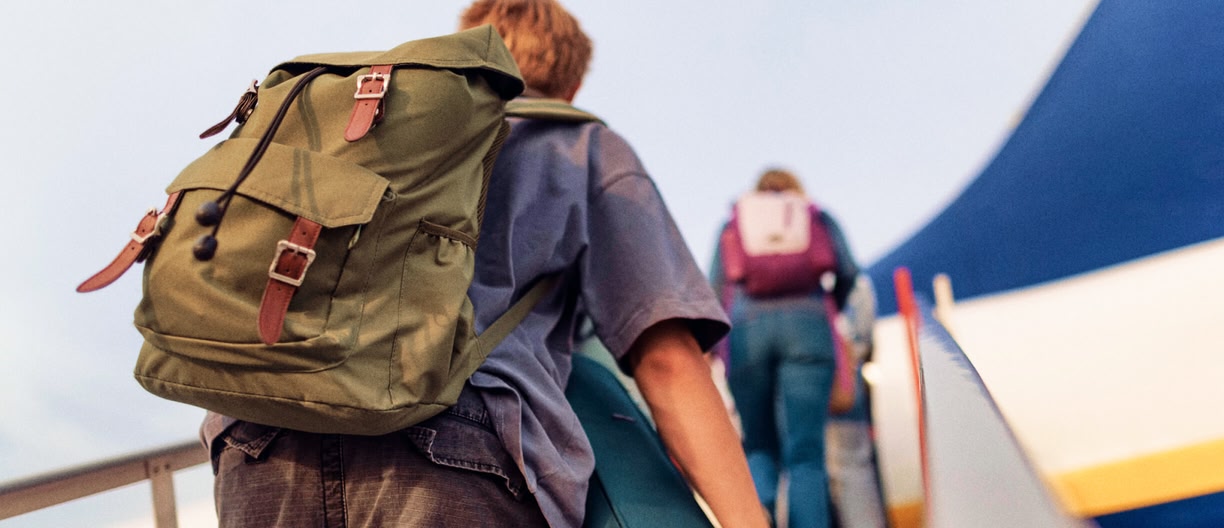
Learn how to avoid carry-on or excess baggage fees at the airport to save your cash for more travel fun.
It's tough to keep track of airline baggage fees, and you may end up paying more than you need to for your carry-on or checked bags. By following these tips on how to avoid baggage fees, you can breeze through the airport and save your cash for the rest of your travel budget.
9 top tips on how to avoid baggage fees
Follow these eight tips to avoid baggage fees and enjoy a seamless experience at the airport.
1. Travel with a carry-on only
Travelling with just a carry-on is the most straightforward way to avoid checked baggage fees. Even if your airline charges carry-on fees, it's usually cheaper than a checked bag. Plus, travellers with only a carry-on bag can head straight to security for their departure (assuming you have a digital or pre-printed boarding pass), skip baggage claim on arrival, and avoid lost luggage.
2. Know the airline’s baggage allowances
Check ahead to know the restrictions on carry-on bags and checked bag allowances for your airline. Fares also differ in their allowances, with the cheapest only permitting a personal item. Higher-tier fares sometimes include up to two checked bags without additional fees. Get a refresher on carry-on liquid limits, too.
Below is a breakdown of typical baggage allowances.
Item | Maximum size |
|---|---|
Carry-on bag | 56cm x 23cm x 36cm Must be able to lift in the overhead bin without assistance. |
Personal item | 41cm x 15cm x 33cm Must fit under the seat in front of you. |
Checked bag | Up to 157cm (linear dimensions) and 23kg |
3. Pre-book your luggage with your airfare
As a general rule, luggage costs more the closer you get to your departure, with the highest fees for checking a bag at your gate. Instead, plan ahead and pay for your luggage when you purchase your fare to save significantly on fees. You can also purchase luggage at a reduced cost by modifying your fare after purchase or by checking in online.
4. Pack strategically
Packing efficiently can save money on avoidable luggage fees. Many travellers roll their clothes instead of folding them to save space, while others use compression bags to save even more. The best packing method takes a flexible approach—roll t-shirts, leisurewear, and other everyday clothes, but flat-pack chunkier or delicate items.
5. Weigh your luggage at home
Weigh your bags before heading to the airport to avoid airline baggage fees or rushed repacking in the middle of the airport. If you’re over, move items between your carry-on baggage and checked bags to redistribute the weight. Carry-on luggage has previously been limited by dimensions, but airlines are increasingly likely to weigh your suitcase or backpack.
Get even more travel-savvy with a lightweight travel scale—these cheap devices strap onto your luggage and calculate the weight when you lift them, so it's easy to quickly check your bag whether at home or in a hotel.
6. Focus on the essentials
Depending on the nature of your trip or destination, you may be able to travel so lightly that you avoid baggage fees altogether. Most major airlines and fares allow passengers to bring a carry-on bag and a personal item, such as a small backpack or purse that can fit beneath your seat.
Consider what you'll need for the trip, and prioritize the essentials before unnecessary add-ons. As long as you have your passport, wallet, phone, and other personal essentials, you can probably purchase toiletries and other items on vacation.
If you’re going to Hawaii or the Caribbean for an all-inclusive vacation, for example, you’ll be fine with light clothing and comfortable footwear, and you can probably leave your Canadian winter jacket at home. Choose versatile items, too—plan your travel wardrobe for mixing and matching so you can have an outfit for any occasion without bringing half your clothes along.
7. Dress in layers
Canadian airlines may weigh your baggage, but they don’t weigh your body. If your luggage is overweight, see what you can wear on your person at the airport without giving yourself a marshmallow-like silhouette. Wear your heaviest clothing items and footwear, and de-layer once you’re on the plane. You can usually take a coat on board in addition to your free carry-on bag and personal item, so you don't need to wear it on the plane if you tend to run hot.
8. Pick the right bag
Most luggage is designed for general flight limits, but it isn't one-size-fits-all. Check your airline's baggage restrictions ahead of time, including allowed dimensions and weight, then consider your travel needs. Mainly, avoid overly heavy luggage that takes up your limited allowance.
For versatility throughout your travels, choose a bag with expandable compartments. If you're travelling with electronics, choose hard-shell luggage with cushioned compartments designed for laptops, cameras, and similar devices. A front-access bag also makes it easier if check-in or security needs to inspect your batteries.
For more adventurous or sports-inclined travel that requires you to bring oddly shaped equipment, take a soft-sided or duffel bag. As a bonus, travel duffel bags often have backpack straps or can convert to rolling luggage if needed. If you're hiking, consider just bringing your hiking pack—these bags are already optimized for lightweight travel and are small enough for overhead compartments, so they're perfect if you don't want to check a bag.
9. Pay one-way
This tip is a combination of the previous tips for avoiding baggage fees. If you can get to your destination by travelling with carry-on only and by dressing in layers, don’t pay for checked baggage on your flight there. Instead, book a checked bag only for your flight home—you'll pay baggage fees only for the return trip, cutting the cost in half.
Take the largest carry-on suitcase allowed, even if it’s only half full. Pack another soft-shell carry-on bag inside, then split your items between the two bags and check the larger bag on your way home. Since many vacations involve at least some shopping and souvenir purchases, you can use your new purchases during your trip, then bring them home in your prepaid baggage. End up with new items for your trip home and some new things to wear during your vacation days.
Navigating baggage fees on Canadian budget airlines
Many Canadian airlines allow you to take two carry-on items on board for free, but there are some budget options that don’t. Many airlines now offer ultra-basic fares that include only a personal item, with extra fees for carry-ons.
All other baggage is subject to additional fees, depending on the airline, fare, and destination. In general, fees are higher for long-haul travel and for economy fares. Premium economy, business class, and first class usually have reduced fees or included baggage but are still subject to fees for overweight bags or more than two pieces of luggage.
Here are the current charges for most Canadian airlines:
Airline | Basic baggage allowance fees | Over-allowance baggage fees | Overweight/oversized baggage fees |
|---|---|---|---|
1st bag: $45–$108 2nd bag: $50–$144 | $100–$120 | $100–$120 | |
Flair | 1st bag: $49–$164 2nd bag: $69–$279 | Speak to a Flair agent | Overweight: Base fee plus $9–$23 per kg up to 45kg per bag Oversized: Base fee plus $99–$139 |
1st bag: $40–$124 2nd bag: $60–$159 | $150–$248 | $150–$177 | |
1st bag: $62.50–$100 2nd bag: $78.25–$145 | Not permitted. Speak to an Air Transat agent for cargo options. | Overweight: Base fee plus $100 Oversized: Base fee plus $100 |
Information accurate as of July 17, 2026. Information and baggage fees are subject to change. Always check the baggage policy of the airline you’re flying with before booking or travelling.
Avoid baggage fees and save on flights
Getting the most out of your adventure often starts with careful budgeting and knowing where you can save. Pack smart and travel cheap on your next trip with these tips on how to avoid excess baggage fees.
Frequently asked questions: Avoid baggage fees
Skyscanner can help you find the best flight, hotel, and car rental deals for your next trip.


